Friday, 16 October 2020

WHOLE, CITUSY ROASTED TROUT (En Papillotte)

I've made this recipe a few times, either with the fish arranged in a baking dish or sealed up in parchment and aluminium foil parcels. There is something about the parcels which better seals in the flavour and enhances the taste of the fish. If you make the recipe in a baking pan, add a little water or wine to the pan and cover the top while cooking. 


INGREDIENTS:


2 whole trout cleaned by the fishmonger. 

2 Yukon gold potatoes 

2 cubanelle peppers (Italian frying peppers) 

two sprigs of rosemary 

1 orange 

1lemon 

1 lime 

1 onion 

olive oil 

dill leaves 

parsley leaves

2 cloves of garlic, chopped well, divided

freshly ground black pepper 

salt


DIRECTIONS:


·        Preheat the oven to 400° F / 200° C. Wash the fish thoroughly and pat it dry with paper towels.  

·        Prepare parchment paper and aluminium foil sections large enough to accommodate each fish. Spread out both sections of the aluminium foil and top it with the two sections of parchment paper. 

·        Slice the orange, lemon, lime, onion, cubanelles and potatoes into rondelles. 

·        Season the potatoes and cubanelles with salt, pepper, one chopped clove of garlic and two tablespoons of olive oil. Divide into two portions and place one portion onto the centre of each parchment paper. Top with a sprig of rosemary. 

·        In a small bowl mix the rest of the garlic, the dill, parsley, black pepper and just a little salt. 

·      Season the fish with the oil mixture, using it to cover both the cavities and the outside of the fish.   

·        Place the onion and citrus slices into the fish cavities. 

·        Place each fish on top of the potatoes and peppers. 

·        Make two well-sealed parcels by folding the parchment over the fish and then folding the aluminium paper over the parchment. 

·        Place onto a roasting pan and bake in the preheated oven for about 30 minutes. The fish is done when its flesh appears opaque. 

·        You could allow the top of the fish to brown if you so wish. In that case, cook in opened parcels for a further five minutes (or more), depending on personal preference. 

·        Remove the fish from the oven and place it on a serving platter alongside the potatoes and cubanelle peppers. 

·        Drizzle the cooking juices and some olive oil on the top of the trout. Keep warm while allowing the fish to rest for five to ten minutes before serving. Allowing to rest assures that the cooking juices drizzled on top will be absorbed into the flesh of the fish.

Wednesday, 1 April 2020

Fudgy Brownies: The Katharine Hepburn Brownie Recipe


Baking in the time of the Covid-19 lockdown:
We had foxes roaming the neighbourhood! Most had red fur, and a few had white fur. The foxes were the only part of the lockdown I didn't mind. 
Today is 12 April 2023, and I am perusing this blog in search of my recipe for Greek Easter Bread, which I intend to make tomorrow. Easter is just a few days away. But I came across this post and clicked on it because I remembered when I had written it. Look at the date: 4/1/2020. That was the covid lockdown year and actually, it had been mere days since we had entered lockdown in our area (23 March 2020). What a surreal plight! We all did our best to keep busy, to understand what was going on, and to function as normally as possible under the circumstances. But we lived dystopian lives. Friends died, they left us, left the earth. As of this writing, more friends are dying. 
What did I do in 2020? I did what the New York Times wrote that everyone else in lockdown was doing: I baked things and cooked things. I read, pulling books from my bookshelves and ordering books online. I thought I was going to write but I didn't, although I tried. Unfortunately, one can't be forced into writing. I got depressed and felt isolated and hoped that when I drove to the supermarket or drove to see a family member (the latter being inadvisable according to the authorities), well, I hoped I was not going to be stopped by the police and asked where I was headed. I remember the police roadblock close to our local hospital ... I remember getting yelled at by a woman for forgetting to wear a mask. I remember how hot it felt to wear a mask and how difficult it was to breathe through it. I remember shopping for masks online, trying to find ones that matched my outfits. True, ridiculous, ridiculous, true, and we all did it, men and women. We were also wearing makeshift masks back then and let's admit it, all our masks were ineffective, which means they were useless, but we were ordered by a loud little fellow who lived in Washington DC, a Dr f something or other, we were ordered by him to wear them. And wear them we did. We obeyed. I saw all sorts of masks: Bandanas were turned into maks ... Fishnet stockings were turned into masks ... Good for Mardi Gras, those masks.   
Was I scared? I certainly thought the Covid-19 respiratory virus was one serious virus, but I didn't think it was as lethal as the authorities made it out to be. With good treatment, one could survive it.
I was more numb than anything else. I was in disbelief. I was in emotional pain. And yes, depression was always looming around, although I avoided acknowledging it because if I did, I was certain that living would become too difficult. Let me tell you something: depression knew how to make inroads into my soul whether I acknowledged I was depressed or not. It revealed itself in various ways. I found myself inhabiting an unending science fiction movie that had come to life. 
I hope neither I nor anyone else has to live under similar circumstances ever again. We are social creatures and we love freedom. Under oppression, while imprisoned, we change; we become diminished. Life is precious. Hug one another and remember what a gift it is we have, our life. Also, don't forget to love. Give it away, give love. Trust me, you won't run out of it; there will always be more of it inside you. Don't be ashamed or reluctant to show love, don't measure love, don't attach conditions to it, just give it, give love.

Here's the original post with its recipe:
This recipe has a well-deserved cult following, and might I add two more facts: it's a great recipe and it's definitely a recipe for chocoholics. Notice the scant amount of flour as compared to the chocolate! These brownies are gooey and fudgy! Whatever I’ve marked as optional is not included in Ms Katharine Hepburn’s recipe, but I have found that the few extra ingredients that I add give a whole new depth of flavour and they temper the strong taste of chocolate. If you crave the strong taste of chocolate, leave them out. I cut down on the amount of sugar used but the brownies are still sweet enough!  I use 3/4 of a cup, whereas Ms Hepburn liked 1 cup of sugar. Either walnuts or pecans can be used here, but I prefer walnuts (unless I am in the mood for pecans). Slice these brownies into small pieces — about twenty pieces per recipe — and keep them in the refrigerator; they do taste better cold. They can be frozen, too!

Ingredients:

1/2 cup good quality Dutch-process cocoa powder such as Guittard or Callebaut 
1/2 cup butter (115 grams or one stick) 
1 teaspoon instant coffee (optional)

2 eggs

3/4 cup sugar
1/4 cup flour
1/4 teaspoon baking powder (optional)
1 cup chopped or broken-up walnuts
1 and 1/2 teaspoons vanilla extract
1/8 teaspoon cinnamon (optional, sometimes I use it, sometimes not)
 1/8 teaspoon of salt


Directions:
  1.     Preheat the oven to 325° Fahrenheit / 160 ° Celsius. 
  2.     Line an 8x8-inch (20x20 cm) pan with parchment paper. The brownies will stick and will not be easily removed from the pan without the use of parchment paper. Lightly grease the top of the parchment and set the pan aside. 
  3.     Combine flour, nuts, salt, and baking powder. Set aside. 
  4.     Bloom the cocoa: Melt the butter and cocoa in a saucepan, stirring until smooth. Add the coffee and stir. Let cool slightly. 
  5.     Transfer to a large bowl and add the sugar. Beat with an electric mixer until the sugar is dissolved. 
  6.     Add the eggs one at a time, beating after each addition. Add the vanilla extract and the cinnamon. 
  7.     Add the flour mixture to the cocoa mixture. Mix just until combined. 
  8.     Pour into the prepared pan. Bake for 35 minutes, but do not over-bake; the brownies should be gooey and fudgy. Let cool, then remove from the pan and cut into bars. 
  9.     Cut into small pieces because these are rich brownies. I usually get 20 pieces. Place the brownies in the refrigerator. To me, they taste better cold. And yes, these brownies can definitely be frozen. 
  10.    Sometimes I add the walnuts on top rather than mix them in the batter. Try it, it certainly makes the brownies look more enticing. 
  11.     What is your favourite Katherine Hepburn movie? You can only pick one. What? My favourite? Bringing up Baby. That's the first thing that came to mind, so it must be Bringing up Baby. It's goofy, and she's fabulous in it, although when she eats, she goes for olives, not brownies.   

Sunday, 14 July 2019

Greek country-bread / Horiatiko Psomi


TO PREPARE THE YEAST:
2 tablespoons of active dry yeast
1/2 cup lukewarm water
1/2 cup whole wheat flour
1 tablespoon sugar

In a medium-size bowl dissolve the yeast in the water. Add sugar and the flour and mix until no lumps are left. Let rise for about twenty minutes.

FLOUR(S):
8 cups bread flour 
or
4 cups whole wheat flour
1 cup semolina flour
3 cups bread flour 

If using more than one type of flour, sift them together so that they are well mixed. You can play around with the amounts of bread flour and wheat flour you'll use, however, the ratio here, which includes a high quantity of whole wheat flour, is good for one's glycemic index.

LIQUID INGREDIENTS:

2 cups water at room temperature 
8 tablespoons olive oil 
4 tablespoon honey
1 tablespoon salt 

Plus:

Some extra flour as needed for the work surface 


Directions:

Add the water, oil, sugar, and salt to the bowl of an electric mixer equipped with the hook attachment and mix for about two minutes.

Add the reserved yeast mixture.
Mix on low speed for about a minute. 
Begin slowly adding the flour and keep mixing at a low speed. The dough will be ready when it begins to pull away from the sides of the mixing bowl. 

Turn out onto a floured work surface and continue kneading until the dough is smooth and no longer sticky. 

Place the dough in a lightly oiled bowl and roll it around in the oil until it's covered on all sides. Cover the bowl with a towel and allow the dough to rise until it has doubled in size, about two hours. 

Punch down the dough and move it on a floured work surface. Knead it for about a minute or so and divide it into two to three equal portions. Shape each portion into a loaf.

Place the loaves onto ungreased cookie sheets.
Score the tops to your liking. 
Cover each loaf with a towel, and allow to rise for one hour.

Have the oven preheated to 400 degrees Fahrenheit/200 degrees Celcius.

Bake for about thirty-five minutes. You'll know the bread is done if when tapped on the bottom the loaves sound hollow. Allow the bread to cool before slicing.


Saturday, 18 May 2019

The Broccoli Experience: Broccoli Yoghurt Salad with Fruit


All the broccoli enthusiasts are bound to adore this gorgeous salad! It's festive and it's both tangy and sweet. It's got multiple tastes and textures to enjoy which blend together very well. Even if one dislikes broccoli ... I don't think there are any people who dislike broccoli, but even — let's say hypothetically, even if there were, there is so much going on in this salad that the broccoli can be overlooked very easily. 

Ingredients: 

  • 2 bunches of broccoli florets 
  • 1 small red onion, sliced
  • 1 cup grated Cheddar cheese

  • 1 cup seedless grapes, halved
  • fresh pineapple cut into cubes, enough to measure one cup
  • 1/2 cup dates, chopped

  • 1/2 cup chopped walnuts
  • 1/4 cup pistachio nuts

  • 1 cup Greek yoghurt
  • 2 tablespoons lemon juice
  • 1 tablespoon olive oil
  • 1 tablespoon honey

  • Directions:

  • Make the dressing:
  • Combine the yoghurt, lemon juice, olive oil and honey. Mix well.
  • For the salad:
  • Into a large serving bowl combine the broccoli florets, cheese, grapes, pineapple, dates, and nuts. Pour the dressing over and toss.

Sunday, 12 May 2019

A GARLIC CONFIT RECIPE


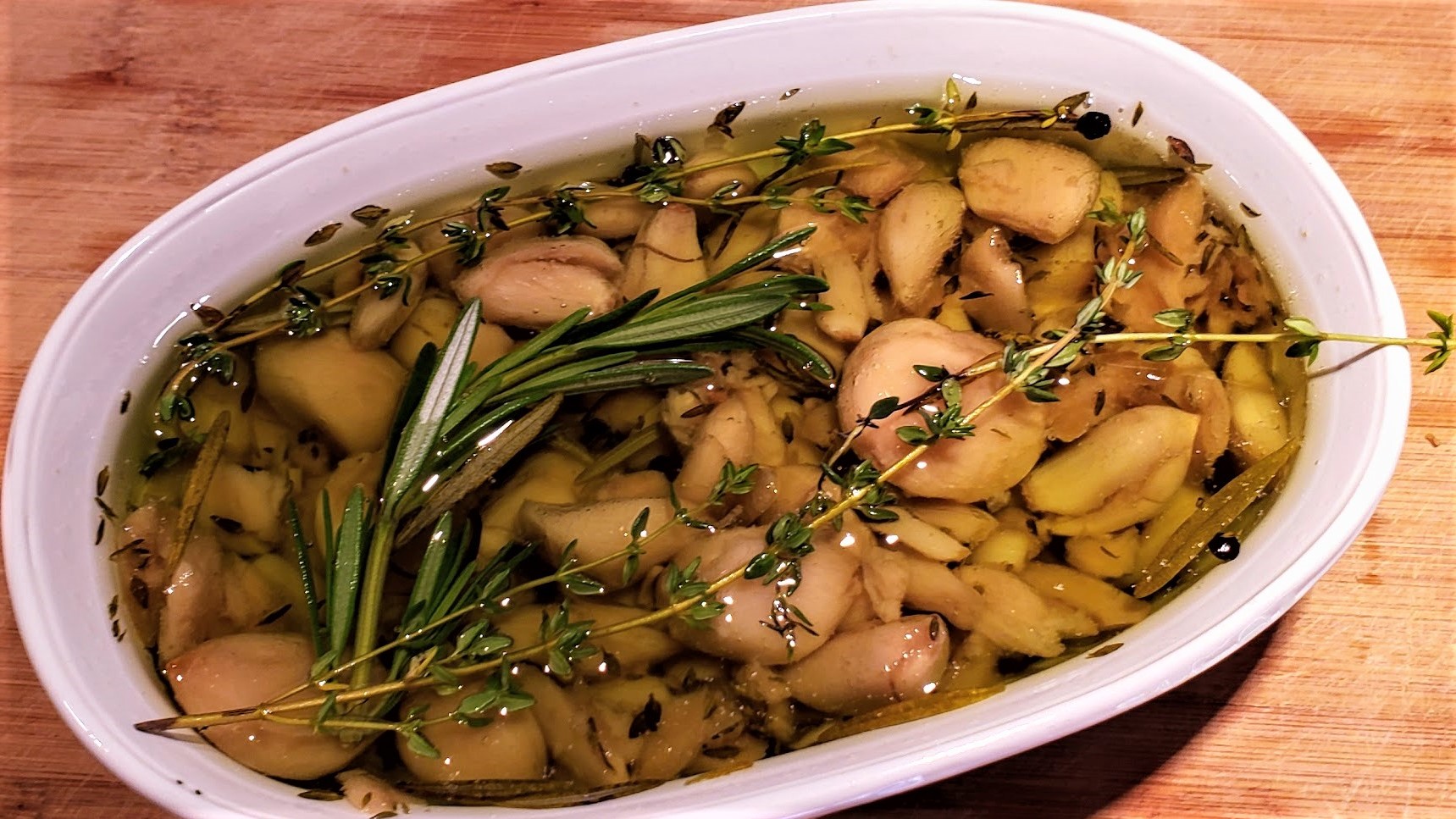
Ready for the oven. It's garlic and it will still emerge as garlic, but better: Soft, mellow, a little sweet, and without garlic's "garlic kick." 


Garlic confit is made by slow-cooking garlic in an herb flavoured oil bath. During this process, the water content in the garlic is cooked out causing the garlic to attain concentrated flavour while losing its sharp acidic taste. The trick is to cook the garlic on a low setting so that it doesn't start frying.  If it does ... Well, if it does, we get rid of it and begin all over again.  


Let's face it: whatever its merits, the taste of raw garlic is heavy and may cause stomach upset. However, there is always that lovely concoction known as garlic confit which comes to the rescue by transforming raw garlic into a wonderful and mashable condiment. Yes, garlic confit changes the taste of garlic from pungent to soft, sweet, and mellow! 


Confit, from the French, is a centuries-old method of cooking an ingredient in its own fat. However, since garlic contains no fat, garlic confit is cooked in an oil bath. The type of oil used is important; one needs something with a high smoke point. The best choice for the job is grapeseed oil. 


Each time I need garlic confit I make only a small batch. It's easy and quick to make. I reserve what I must use and have a leftover portion for adding to recipes during the week to come. 

How about some garlic confit on garlic bread??? Try it! Use it in marinades or use it to flavour vegetables and sauces. Try it in pesto sauce! How about the oil it's cooked in? Mix a couple of tablespoons into olive oil to flavour vinaigrettes! 


Ingredient list:

Two heads of garlic (or three if they are small), separated into cloves; each clove should be peeled 
Grapeseed oil to cover the garlic
Sprigs of thyme
One sprig of rosemary
Two bay leaves
About 10 peppercorns

How to make garlic confit:

I start by peeling two heads (or three if they are on the small side) of garlic. Peeling a lot of galic cloves can get very boring! Sometimes I whack the cloves with a knife so they're easier to peel, but I try not to whack too hard as I don't want to wind up with flattened garlic. 

The oven is preheated to 275°F/135°C


I get ahold of a small baking dish. Inside, I place the peeled garlic cloves, two bay leaves, sprigs of thyme and rosemary, and peppercorns. 


I add the grapeseed oil to cover. Then, I place aluminium foil over the dish and pop it in the oven. 
Baking takes about forty minutes. When the garlic cloves become soft and slightly golden in colour, the metamorphosis has occurred: behold the garlic confit! Since every oven is different baking times will vary, therefore check the garlic a few times so that it doesn't get burned. And no leaving the house! Stay right there in the kitchen and keep an eye on your developing masterpiece because it can go from confit to unfit in mere minutes.

To store: Cool the confit and transfer it (oil included) to a clean resealable jar. 
During cooking, the garlic loses its acidity, therefore bacteria will build up if the jar and its ingredients are not kept clean and refrigerated. The jar must always be kept refrigerated and care should be taken that the lid and mouth of the jar aren't contaminated. Each time garlic is needed, it must be retrieved with a clean utensil. Don't place the same utensil in the jar twice. If more confit is needed, another clean utensil should be used. The maximum storage time for garlic confit is a week to ten days at most. No need to waste it ... make only a small portion. And enjoy that garlic confit garlic bread!!


Proud I've finished this post without making any of the obligatory jokes about garlic and vampires ... 

Sunday, 7 April 2019

A FRENCH APPLE CAKE


Ingredients:

5 apples, not too large, choose a few different baking varieties 
some cinnamon and brown sugar
the zest and juice of one small lemon
1/2 cup sugar
1/2 cup all-purpose flour
1/4 cup almond flour
1 teaspoon baking powder
2 eggs
1 teaspoon vanilla extract
1/4 teaspoon salt
8 tablespoons unsalted butter, melted and cooled
some apricot or apple jelly, melted in the microwave when ready to use


Directions:

  • Reserve one of the apples. Peel the other four and remove their cores. Cut them up into 1-inch pieces. Place them into a bowl and sprinkle some cinnamon and brown sugar over them, mix, cover and set aside.
  • Mix the lemon zest with the sugar and set aside.
  • Preheat the oven to 350°F/180°C.
  • Grease a spring-form pan and place it on a baking sheet that’s lined with parchment paper.
  • In a bowl, mix the flour, almond flour, salt, and baking powder.
  • In the bowl of a mixer, beat the eggs until they are foamy. Add the sugar and beat until it’s incorporated and has dissolved.
  • Add the vanilla and lemon juice. Mix well.
  • Remove the bowl from the mixer.
  • Using a rubber spatula, fold in one-third of the flour mixture, then add one-third of the butter. Folding gently, repeat this process two more times, until all of the flour and butter have been used. The mixture should turn out smooth and a little thick.
  • Gently fold the apples into the batter. 
  • Add the mixture to the spring-form pan.
  • Peel the reserved apple, slice it, and arrange it over the cake batter. 
  • Bake for about one hour or until a knife inserted into the centre of the cake comes out clean.
  • Transfer to a cooling rack and allow to rest for at least fifteen minutes. Carefully run a knife around the edges of the cake and open the spring-form pan slowly. 
  • Allow the cake to cool for about an hour. Remove the sides of the spring-form pan.
  • Invert the cake onto parchment paper and remove the bottom of the spring-form pan. Flip the cake onto a serving platter.
  • Glaze the top of the cake with some melted jelly