Showing posts sorted by relevance for query cook the books. Sort by date Show all posts

Saturday, 16 March 2013

COOK THE BOOKS: THE SHAPE OF WATER

"The Shape of Water," written by Andrea Camilleri, featuring the dauntless inspector Montalbano. 

We’re going to Cook the Books again, and this time the vehicle we are using is Andrea Camilleri’s novel “The Shape of Water.”  After reading the novel we are making something to eat. Something delicious.  Something inspired by the book. In my case, I’m choosing to make pasta puttanesca with shrimp! I know, I know, the novel is set in Sicily, and pasta puttanesca is a dish created in Naples. Nevermind. Have you read this book? There are so many ladies of the evening living in its pages that it would be a shame not to honour them with the very popular pasta puttanesca, a truly delicious dish that is purportedly named after these hardworking women.  
  
The fictionalized Sicilian town of Vigata is the setting for Camilleri’s novel “The Shape of Water.” The town comes complete with a “pasture,” which is the name for the al fresco red light district of Vigata. A dead body is discovered in the pasture by local trash collectors, and that sets in motion the action of the novel. That pasture is by no means a pastoral place! No sheep graze there. By the way, did you know that sheep herding is the second oldest profession in the world?   


Pasta  Puttanesca with Shrimp: This post is my contribution to the current edition of Cook the Books.  This round is hosted by Rachel of The Crispy Cook. 

I made this version of pasta puttanesca with linguine, which I mixed in a briny tomato sauce that was flavoured with anchovies, capers and olives. I also added shrimp, which is not traditional, but I wanted to combine the briny taste of the sauce with seafood, a combination which can serve as a reminder of the beautiful seas which surround the achingly beautiful island of Sicily. While dinner was being prepared, I snacked on a mouthful of some crunchy càlia e simenza that I had made the day before.   


Càlia e simenza: lovingly described by the author, here is how our hero, Inspector Montalbano, enjoys this snack:  

“taking the stroll he customarily allowed himself …  along the eastern jetty, out to the lighthouse.  Before he set out however, he always stopped at Anselmo Greco’s shop, a hovel that clashed with the clothing boutiques and shiny, mirrored cafés along the corso…  Greco also sold càlia e simenza, a mixture of roasted chickpeas and salted pumpkin seeds.  Montalbano would buy a paper cone full of these and then head out.”
  
I myself have eaten lots of  càlia e simenza, and it's a wonderful way to pass the time especially when taking a slow, scenic stroll.  Eat some chickpeas, crunch on some roasted pumpkin seeds, look at the scenery, contemplate your navel ... heaven! To make this snack, just open up a can of chickpeas, rinse and dry them really well and place them on a baking pan lined with parchment paper. Sprinkle some olive oil and salt over, add whatever other spices you really love, then bake in a 375  F oven for at least 30 minutes, or until they are crunchy. Roast the pumpkin seeds separately, mix with the chickpeas, and you're in business! Truthfully though, there is no way to make the perfect càlia e simenza at home. The real version is roasted and dried in an industrial setting, and it's something one buys from the street vendor or the corner shop. I spent many happy childhood summers snacking on bags of càlia e simenza. The Greeks (of which I am one) and the Sicilians have many things in common. Shared foods and recipes are one commonality. I was thrilled to read about inspector Montalbano's habit of eating càlia e simenza; it brought back memories.
  
Camilleri’s "The Shape of Water..." Following are some of my impressions of the novel, but first I include a type of prologue:

Once upon a time, there was a little boy who wanted a pony for Christmas. He started asking for it around September and didn’t stop asking ‘till Christmas Eve. That boy wanted a pony! Early on Christmas day he woke up, got dressed in a hurry, no breakfast, and he ran to the barn. He was sure there would be a pony waiting for him. However, all he saw was a large pile of manure. His father went to the barn and found the boy shovelling the manure. “What are you doing, son?” the father asked. “Looking for my pony,” said the boy. “With all this manure, there has to be a pony in here somewhere!”


Just like the boy in the anecdote, I did quite a bit of shovelling as I tried to find the pony in Andrea Camilleri’s novel “The Shape of Water.” Throughout the pages of the book, I met pimps, prostitutes, drug addicts, hoodlums, and corrupt politicians. I heard more than enough base and obscene language, and I failed to laugh at numerous crude jokes. I found out that the novel included inferences to incest, one of the most reprehensible types of human behaviour. As I shovelled along, guess what happened? My pony appeared!  It arrived on the scene in the persona of the dauntless Sicilian police inspector Salvo Montalbano, who ploughed through layers of corruption in order to solve the murder of a politically and socially prominent man who as it turned out was killed ... from natural causes. 

The action of the novel unfolds in Sicily, unrecognizable in Camilleri’s rendering. The scenery is mostly limited to trash-strewn vistas and dilapidated buildings, and there is a meagre supply of likeable people.  Montalbano is described as a man in love with his native island, but there’s not much that's described to love here. Except for the food. When the inspector takes a break from police work, he usually finds something very interesting to eat, and what he has to eat always gets a favourable description.

Montalbano dined on boiled shrimp and pasta, which can be easily transformed into pasta puttanesca with shrimp. Just add the puttanesca sauce on top of the shrimp and pasta, mix and enjoy!  


People like Montalbano, who are involved in solving crimes, have to contend with sordid circumstances and disreputable individuals.  The details of this unsavoury type of work are clearly narrated by the author. I came to develop a liking for Montalbano.  Underneath a tough exterior, he hides a heart of pure gold. He doesn’t always follow the letter of the law, but that’s because he prefers to protect the innocent from the claws of the corrupt kingpins, the latter of which can shape the law to fit their own needs. The law of the corrupt can take on any shape, just as a volume of water can take on any shape depending on its container. Hence, the title of the novel makes sense. Montalbano is a man of the people. Of the struggling,  sometimes fallible Sicilian people. Despite the pressure put upon him by his superiors, our inspector does not give up until he figures out the details which led to the victim’s death from nothing but ... natural causes. Yes, the fellow did die flagrante delicto, but as Montalbano discovers, the dead body was moved around a few times between the time of death and the time of discovery. In the end, the inspector is able to help and protect some people who would have otherwise gotten framed. However, nothing can be done about the kingpins. They go on. 

This novel was written in 1994, during a time of great unrest in Sicily. Mafia wars had caused a significant amount of bloodshed. The politicians were on the take, the average people were scared, and unemployment was high. In the novel, the island is occupied by soldiers from the mainland. This, in fact, was a reality. The Italian government had sent peacekeeping troops into Sicily following the murders of prominent anti-mafia judges. The troops remained in Sicily until 1998; the military operation was dubbed "The Sicilian Vespers" (I Vespri Siciliani, after Verdi’s opera). 

In “The Shape of Water,” Camilleri points his finger at the political and criminal upheaval of 1990’s Sicily. I suppose that was Camilleri’s way of pointing his finger at what was going on, and his way of prompting average Sicilians to keep fighting back in order to reclaim their island. It's not merely a murder mystery Camilleri wrote. Through a subtext of social criticism, he exposed the repulsive nature of a corrupt society. 

Finally, since I did mention Verdi’s “I Vespri Siciliani,” how about some Sicilian fun?  For our enjoyment, a clip of “Mercè, dilette amiche,” Elena's aria from Act V of "I Vespri Siciliani." I listened to every rendition available on YouTube, from the best to the not so good. I loved this version, recorded in 1955. Maria Callas sings, with Tullio Serafin conducting. Of course, I could also mention Sutherland, who is superb in it, but what makes this version different is that Callas feels each word she is singing!

Enjoy listening to Verdi and Maria, and I hope you smile when you hear that beautiful E at the very end. This difficult aria is rendered so, so beautifully! 

Monday, 29 July 2013

WHEN YOU'RE EATING TO LIVE TRY THE POLENTA: REFLECTIONS ON READING MFK FISHER'S "HOW TO COOK A WOLF"

“By all means marry; if you get a good wife, you'll be happy. If you get a bad one, you'll become a philosopher.” That’s what Socrates said, and it’s well known that he had an unhappy marriage. Therefore, he became a philosopher. I imagine his wife was a horrible cook because soon after Socrates became a philosopher he coined this phrase: “Eat to live, do not live to eat.” I think what Socrates meant was not to be a glutton or engage in debauchery. Keep to the middle of the road, don’t go overboard. 

I like to remember the “eat to live, do not live to eat” quote every time I go to the supermarket. Everything there is strategically arranged to tempt the buyer! That’s what you call marketing (pun intended). Before you know it, you’ve bought a whole host of things that you have no use for. That’s excess, and that's not a good thing. Socrates would be disappointed as would be MFK Fisher; MFK eschewed excess. Of course, when times are hard, excess is difficult. When the "wolf is at the door," meaning when one is faced with difficult times, ingenuity must come into play. 

MFK Fisher’s book “How to Cook a Wolf,” written during World War II, is devoted to giving ideas on how to eat well during hard times. The book's premise is how to master the proverbial wolf rather than let him threaten. Keep calm, be ingenious, and persevere. That's "How to Cook a Wolf!" Clever title, enjoyable book. This was my introduction to MFK Fisher (Thank you, Simona). Fisher was a bohemian, a cook, a gourmet, a journalist and a pioneering food essayist. In her book, she discusses food shortages, rationing and other difficulties faced in the US during the World War II.  

Her observations about food contradicted what was commonly believed at the time, but she was right on target: Eat lots of fresh vegetables she said. Have a nice, big salad. Don't forget about seafood. If you have wilted vegetables, they're perfect for soup. Make sure your eggs are fresh, even if you have to pay a little more. It will be worth it in the end. Make your food stretch by adding rice or potatoes to it. Save on gas: your oven can accommodate more than one dish at a time. Add the dessert in there along with the main course ... Her ideas about fresh food and food economy are conveyed in a clever, appealing manner. One of these days I may have to try baking her tomato soup cake. Tomato soup? In cake? It's been heard of. It was a pretty common Depression-era and wartime addition to spice cake. Tomato soup was the "mystery ingredient" which allowed cooks to economise on the use of oil/butter, milk, eggs, and sugar. MFK doesn't tell us, but tomato soup makes a cake moister and sweeter. Of course, you know ... don't add it when making a genoise ... 


 MFK Fisher's "How to Cook a Wolf" is the entry for COOK THE BOOKS CLUB,  this round hosted by Simona from BRICIOLE.  Read the book, cook what inspires you from the reading, then blog about it.  That's the objective! 

I would not have been able to praise Fisher had I not decided to write what follows, some of my thoughts concerning food shortages in wartime Europe. Once I had those thoughts on paper, I felt a sense of relief and was able to go back and reread "How to Cook a Wolf" with enjoyment. It was Fisher's chapter on how to manage during blackouts that brought back memories of stories heard from relatives concerning how they dealt with blackouts. And with curfews, too. And with fear. During World War II, my family lived in Greece, which was under nazi occupation. Things there were just a tad more serious than in the US (of course, if not for US soldiers, who knows what Europe would look like today). 

In her book, Fisher explained such things as how to cook a tough cut of meat. During the war, my family felt they were rich if they could eat bean soup for dinner. My grandfather was imprisoned and nearly shot because he bought meat from someone who butchered a cow without having gotten permission from the authorities. Needless to say, the man who butchered the cow (his own cow), was shot. Shot dead. Knowing all these stories, plus lots more, I initially reacted to Fisher’s book with commingled feelings: with interest, because this is a charming book, but also with disdain because I knew and sympathised with people who had it a lot worse than Fisher's intended readers. In wartime America, food was plentiful albeit rationed. In Greece, food was a luxury and near starvation was the norm. Tell me MFK, how do you make a nice meal out of just a handful of raisins? I really don't think MFK, knowledgeable as she was, would have had an answer.

But if during World War II my relatives considered beans to be a rich meal, polenta was their staple meal. They would eat polenta nearly every day. My grandfather was the polenta guru of the clan, cooking it over an open fire in the yard, and stirring it all the long time it needed to be stirred. Then he would take it to my grandmother who poured it onto a platter and flavoured it either with petimezi (a syrup made from grapes), or with feta cheese: Polenta made either sweet or savoury. My mother once told me that she loved the sweetened petimezi polenta. I believed her 100 percent because mom was known for her sweet tooth and for the desserts she made! 

Fisher has a very nice recipe for polenta in the chapter "How to Pray for Peace," and she aptly describes the starchy cornmeal concoction that is polenta as "a sturdy... mixture, the kind that has survived centuries of loving obedience from hungry, simple peoples."  
   
Strapatsada

I would like to dedicate this post to the persevering spirit of my relatives and the like-minded spirit of all war-torn families. For this entry of Cook the Books Club, I cooked two dishes that I heard lots about from my mother: Strapatsada, a dish made with tomatoes, eggs and feta cheese, definitely a luxury food during the war. Strapatsada is reminiscent of Fisher's recipe "eggs in purgatory," known across the pond that is the Atlantic Ocean as "uova in Purgatorio." 

I also made polenta, which was my family's wartime staple. After the war, polenta all but disappeared from Greek dinner tables, but strapatsada is still a favourite.

Here is a pertinent war-time story: my cousin Socrates was born during World War II. I am very fond of Socrates, he is a righteous dude. He is named after Socrates, the philosopher. This is how that happened:

Soon after he was born, the yet unnamed baby Socrates was taken to church, ready and willing to be christened. It’s a Greek tradition to name the newborn after his or her grandparents. And there was the problem. The baby's mother wanted her son to have her father’s name, and the baby's father wanted his son to have his father’s name. For days, the back and forth had been: 

"It's going to be Nicholas!"
"No, it's going to be Constantine!"

Husband and wife could not agree (sound familiar)? They arrived at church still arguing about names. Now the godmother of the baby was to be my mother, who at the time was about 12 years old. Godparents in Greece have special powers. They can execute a coup, and give the baby a name of their own choosing. My grandfather saw that the argument between the baby’s parents was not going to be settled anytime soon, so he approached my mother. 

“Tell the priest to name the baby Socrates,” he whispered in her ear. 

As a compromise, grandfather decided to have the baby named after one of the famous ancient Greeks. You know, Socrates, the philosopher who said “eat to live, do not live to eat.” So the ceremony started, and when the priest asked:

“What is this servant of God going to be named?” my mother belted out: 

“Socrates!” 

So Socrates it was, and Socrates it is. After every christening, there always follows a big celebratory dinner. That’s the point of this story: what do you serve when there is nothing much to be had? Vegetables! My grandparents grew tomatoes in their yard. Plus they had some chickens they kept for the eggs, plus they always managed to get feta cheese. (How they got feta cheese during the war is a very long story. I can email you the details). With those ingredients on hand, they made strapatsada. Lots and lots of strapatsada. And the sweet kind of polenta. And a salad too. A really big salad. Plus they had homemade noodles flavored with olive oil and more feta cheese. Then, there was fruit for dessert. My mother always spoke about that dinner. In the midst of deprivation such a feast made a big impression. I think MFK Fisher would have been pleased with the results. 

Thank you for reading my post, but I am not finished. Reader, hang on. I have one more thing to add: 

Socrates, I love you! 


Friday, 22 March 2013

PASTA PUTTANESCA with SHRIMP and FETA

I got the idea to make pasta puttanesca with shrimp and feta cheese when I was reading Andrea Camilleri's novel "The shape of water," featuring the character of Inspector Montalbano. I was reading the book for my participation in Cook The Books Club, and I had to think of something nice to make that reminded me of the book. The shrimp, the briny sauce, and the briny feta cheese bring to mind the seaside where inspector Montalbano likes to stroll. 

This is an enjoyable dish and very easy prepare. I love how Greek and Italian ingredients are combined here: strong Mediterranean roots! This dish depends on freshness, therefore, working quickly when preparing it is a must. I had the idea of garnishing the pasta with some fresh grape tomatoes which are very abundant at the market this time of year. They are imported all the way from Mexico and are very tasty. 


Linus happens to love pasta and today he is waiting patiently for his share.
Ingredients:


olive oil
1/2 pound shrimp, peeled and deveined
1/2 pound linguini
2 teaspoons fresh thyme leaves
1 teaspoon dried oregano
2 tablespoons crumbled feta cheese, plus a little more for garnish. 
two or three sun-dried tomatoes, chopped
3 Roma tomatoes cut into chunks (seeds and skin removed)
some grape tomatoes cut in half, to be used for garnish
4 anchovy fillets
2 tablespoons capers, rinsed
1 teaspoon red pepper seeds, or use more if you prefer
4 cloves of garlic, chopped
10 pitted Kalamata olives, sliced in half
¼ cup fresh Italian parsley, chopped

Directions:

  • First, prepare the pasta and shrimp: 
  • Fill a large pot with salted water and bring it to a boil. Add the linguini and cook according to package directions. 
  • Drain the pasta and place it in a large bowl. Sprinkle some olive oil on the pasta, and mix.
  • Meanwhile, in a large skillet heat 3 tablespoons olive oil. 
  • Add 2 cloves of garlic and sauté for one minute. 
  • Add the shrimp and thyme and cook for about 3 minutes, until the shrimp have turned pink. 
  • Remove from the heat, add the feta cheese and season with freshly ground black pepper. 
  • Add the shrimp mixture to the pasta.
  • Add some parsley and mix well. Cover and set aside.
  • Now make the puttanesca sauce:
  • In a pan heat some olive oil and add the rest of the garlic along with the anchovies, red pepper seeds, and capers. Cook for about one minute, stirring. 
  • Add the olives, the oregano, the Roma tomatoes and the sun-dried tomatoes. 
  • Cook for about 10 to 15 minutes.
  • Add the sauce to the pasta and shrimp and mix. 
  • Before serving garnish with the grape tomatoes and the rest of the parsley and feta cheese.

Monday, 3 December 2012

A CARROT CAKE FOR "HEARTBURN;" My "Washington Carrot Cake."

    
The novel Heartburn by Nora Ephron was published in 1983


It was so easy to become a fan of Nora Ephron! An inveterate New Yorker who occasionally put up with living in such backwaters as Washington DC and Hollywood, Nora Ephron was an author known for her sophisticated prose. She wrote in a spirited manner, hiding soulfulness and vulnerability inside paragraphs brimming with wit and sarcasm. 

In addition to novels and essays, Ephron wrote screenplays, producing and directing some of them when they were made into films. She was a Hollywood power player whose untimely death at the age of 71 came as a shock. 

For years, she had been in remission from leukemia, a condition she chose to keep hidden. She had planned her own memorial, and because she was passionate about food and cooking, she wanted favourite recipes included in the service. She died from pneumonia, a complication caused by chemotherapy. I admired Nora Ephron; her intelligence and creativity remain an inspiration.
  
What initially made Ephron famous was the roman à clef “Heartburn,” a satire based on the collapse of her marriage to journalist Carl Bernstein. He threatened to sue over its publication but never did. I guess “Heartburn” hit Mr Bernstein too close to home. I remember the gossip concerning his infidelity. Mr Bernstein was quite a womanizer, and I have often wondered what compels that sort of man to marry. Why bother? There must be a streak of sadism running through the veins of serial adulterers because they inflict pain on the women they are married to and sometimes also on the women they cheat with. 

Nora Ephron with Carl "Casanova" Bernstein, plus a woman comfortably sitting on Carl's lap. This picture kind of says it all. I guess old Carl had trouble understanding certain concepts, including the meaning of the word "RESPECT." And he wasn't that great of a reporter, either. I'd call him Bob Woodward's lap dog. He was more of an expert at seduction than anything else.

“Heartburn,” is a story of love, betrayal and heartbreak written in a sarcastic style. Humour acts as the salve which makes the heroine’s predicament bearable. This heroine's name is Rachel Samstat, and she’s a cookbook author seven months pregnant with her second child. At seven months she is bloated, her feet feel “like old cucumbers” and she suffers from what she describes as “terminal heartburn.” To compound her misery, it’s at this stage that she stumbles upon the fact that her husband, Mark, is having an affair. What’s more, she's acquainted with her husband’s mistress and on one occasion, had invited her to her home for carrot cake! 

At first, Rachel vows to win back Mark, despite the fact that he confesses he loves his mistress and has never loved another woman as much. Still, he wants Rachel to stay with him, at least until the birth of their child. That's one considerate kind of guy!  

Eventually, Rachel takes her children and leaves the marriage. The catalyst is her discovery that Mark has spent a small fortune as a down payment on a necklace for his mistress. Soon thereafter, a sense of clarity comes to Rachel:

    “You can love someone so much,” she thinks, “that you don’t see anything at all. You decide to trust him and you kind of notice that things aren’t what they were, but it’s a distant bell, it’s through a filter… I can’t stand feeling sorry for myself.  I can’t stand feeling like a victim… I can’t stand sitting here with all this rage turning to hurt and then to tears.”  

Rachel writes the story of her marriage, 

    “... because if I tell the story I can make you laugh, and I would rather have you laugh at me than feel sorry for me. Because if I tell the story it doesn’t hurt as much.” 

In this manner, she can begin to forget. 

The narrative of the novel is interspersed with Rachel’s recipes, some of them quite mouth-watering. There’s even a recipe index at the end of the book:  Cheesecake, page 49. Key lime pie, page 166. Vinaigrette, page 177. 


There’s been some criticism that the characters in the book are not well developed. My answer is that Ephron’s focus is mainly on satire, which is a genre that does not necessarily rely on a heavy-duty psychological evaluation of character motivation. The main purpose of satire is social criticism via the use of wit as a weapon. 

Ephron’s novel was socially significant. At the time of its publication in the early 1980s, divorce rates were climbing, but divorced women kept quiet about their predicament. Ephron was the first to write openly about living with a philandering husband and about experiencing a painful divorce. She empowered women by changing the way divorce was talked about. She encouraged women to talk candidly about it and to share their stories.  

With this reading of “Heartburn,” I am participating in Cook the Books, a bi-monthly (not semimonthly) Internet book club/cooking event that features a different book for each round. The challenge is to read the book chosen, cook something inspired by it, and then blog about it. I chose to make a carrot cake because that's what the unsuspecting heroine of “Heartburn” serves to her husband’s mistress. I was overcome by the potent irony in this exchange between hostess and visitor. And I remembered how popular carrot cake was in the 1980s ... 
Years ago, I found myself in a situation similar to Rachel’s. And yes, I did invite the "other woman" to my home, although not for carrot cake but for a barbeque. One of the most important things I learned from my experience was not to be the victim in a relationship. Love, cohabitation, marriage, all relationships including friendships, should be victim free. Easier said than done, but as Rachel Samstat says in “Heartburn,” when your dream dies, you are left “with a choice: You can settle for reality, or you can go off, like a fool, and dream another dream.” 


WASHINGTON CARROT CAKE

I call this my “Washington” carrot cake. That’s because the recipe was given to me by a wonderful cook and family member who lives in the Washington DC area. This is one of the first cakes I learned to make successfully, and it has been in my cake repertoire since I first made it in the early 1980s. The cake is fruity and tastes like a spice cake. It's made with oil and carrots, so as far as cakes go, I guess it's kind of "healthy." It can be eaten plain; that's why I usually bake it in a 9x13 pan. For a holiday treat, bake the batter in round pans and then slather cream cheese frosting on top, on the sides and between the cake layers.
  
Ingredients
    For the cake:

butter and flour to grease the pan
2 and 1/2 cups flour, all-purpose
2 teaspoons baking powder
2 teaspoons baking soda
2 teaspoons ground cinnamon
2 teaspoons vanilla extract
1/2 teaspoon salt
3 cups peeled and grated carrots (about 10 carrots)
1 cup coarsely chopped walnuts 
1 cup dried and shredded unsweetened coconut, lightly toasted
1 cup sugar
3 eggs
3/4 cup good vegetable oil 
3/4 cup buttermilk 
1 cup crushed pineapple, drained well


Ingredients
    For the Frosting:

8 tbsp. unsalted butter softened and cut into pieces.
1 teaspoon vanilla extract
1 teaspoon grated lemon zest
2 (8-ounce) packages of cream cheese
2 cups confectioners' sugar, sifted

1/2 cup shredded coconut
1 cup finely chopped walnuts

Directions
    For the cake:

Preheat the oven to 325° F.  
Grease and flour a 9" x 13" baking dish with butter and flour. This is an important step, don't forget it.
Gather the carrots, walnuts, coconut, and drained pineapple into a large bowl.
Into a medium bowl whisk together the flour, baking powder, baking soda, cinnamon, and salt. 


Into a really large bowl beat together the oil and sugar. 
Add the eggs one at a time and beat after each addition. 
Add the vanilla and beat in. 
Fold in the flour mixture until incorporated.
Fold in the carrot mixture in batches. Make sure that you don’t over-mix.

Pour the batter into the prepared pan and bake for 45 to 55 minutes.  
Let the cake cool in the pan for about 1/2 an hour. 
Turn it out onto a cake rack and let it cool completely.


If you'd like to have frosting, you can frost just the top if you've baked the cake in a 9x13 pan. If you'd like to have frosting on the top plus the sides and between layers, bake the batter in round pans and adjust the baking time accordingly.


Directions
    For the Frosting:

Use an electric mixer with the paddle attachment.  
On medium speed beat the butter and cream cheese until smooth. Add the vanilla and the lemon zest, beating until incorporated. 
Lower the speed and add the sugar in batches, beating for about a minute between additions. Finish beating by bringing the frosting to a smooth consistency. 
Spread the icing evenly over the cake. 
Decorate the top of the cake with toasted walnuts pieces and coconut. 
Chill before serving.

Monday, 2 February 2015

HAPPY BIRTHDAY LANGSTON HUGHES! Let's have some cinnamon mocha coffee to celebrate!


It's wonderful to participate in Cook the Books once again! For this round, we read "Sustenance and Desire, A Food Lover's Anthology of Sensuality and Humor"  


Chosen for us by Rachel, from the Crispy Cook, the book is edited by Anne Bascove, who goes by the mononym of Bascove, and Bascove also supplied the paintings appearing in the book because after all, she is an artist/illustrator. Have a look:

Still Life with Heirloom Tomatoes, 2003, oil on canvas (Bascove)

Still Life with Melon, 2003, oil on canvas (Bascove)
Paris, 2003, oil on canvas (Bascove)
The anthology is divided into four sections: nourishment, desire, hunger, and sustenance. Bascove chose wonderful pieces of prose and lots of good poetry!  Some of the authors represented are Virginia Woolf, Emily Dickinson, Wislawa Szymborska, Czeslaw Milosz, Marcel Proust, Allen Ginsberg, May Sarton... should I go on? Get the picture? A superb compilation, in a book that should stay on your shelf and be available to frolic with every so often.
  
Langston Hughes, Collection of the Smithsonian National Museum of African American History and Culture.


For my entry, I decided to focus on a poem by Langston Hughes. Not only is it a beautiful poem, but just yesterday, February 1st, was the commemoration of the author's birthday, therefore it seemed very appropriate that I say thank you, Mr Hughes, your poetry has made a difference in our lives and in our culture. The poem is called Harlem Sweeties, and on the Internet, it can be read here.

                   ... All through the spectrum
                   Harlem girls vary—
                   So if you want to know beauty’s
                   Rainbow-sweet thrill,
                   Stroll down luscious,
                   Delicious, fine Sugar Hill.

I was inspired by the poem to make a uniquely flavoured drink: 
Cinnamon Mocha Coffee!


Cinnamon Mocha Coffee contains honey, cinnamon, there is coffee for the most part because it is, after all, a type of coffee drink, there is cocoa also, and a few cloves are thrown into the mix.
All these earthy flavours are in keeping with Hughes' theme, which is that there is an untold and uncounted variety of hues in the integumentary aspects of Harlem Sweeties, and that there is lusciousness in the skin colour of people of colour. Hughes is offering a hymn of praise to African Americans, and by extension to all people who show their courage by embracing difference. Thank you, Langston Hughes, and Happy Birthday!  


Here's the recipe for Cinnamon Mocha Coffee, based on one from Taste of Home magazine:

Ingredients:

1/3 cup ground coffee
3/4 teaspoon ground cinnamon
1 cup milk
2 tablespoon honey
2 tablespoons baking cocoa
1 teaspoon vanilla extract
a few cloves
4 cinnamon sticks

Directions:
  • In a coffeemaker basket, combine the coffee and the cinnamon. Prepare four cups of brewed coffee according to the manufacturer's directions.  
  • Meanwhile, combine milk, sugar, cocoa, cloves and vanilla in a saucepan. Cook over low heat for about seven minutes, stirring occasionally. 
  • Strain the hot milk mixture into four coffee cups, then add the cinnamon-flavoured coffee. Garnish with cinnamon sticks. 
Easy to prepare, a warm drink with a beautiful colour!

drops of honey and sticks of cinnamon, a dusting of cocoa, a sprinkling of cloves

Sunday, 15 January 2012

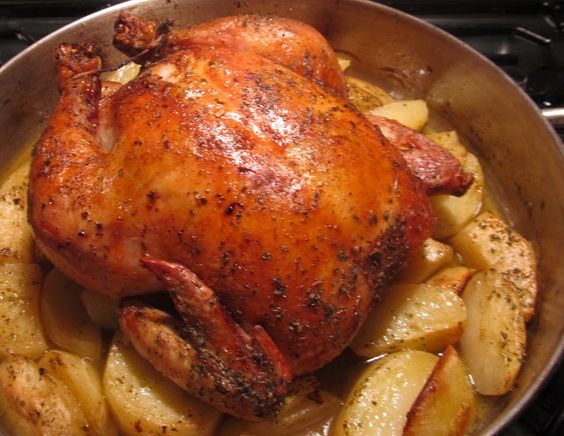
TRADITIONAL GREEK ROAST CHICKEN WITH RIGANI AND POTATOES


First off, although it's easy to guess:  Rigani in Greek means oregano. This recipe is representative of one of the most typical way Greeks prepare roast chicken. It's fast to make and delicious. It contains the holy trinity of Greek seasonings: olive oil, lemon and oregano, and believe me, the chicken here gets seasoned with a lot of oregano. Don't be stingy with the stuff.  I 'm always surprised at how juicy the chicken is when it comes out of the oven! I think the meat stays moist because of the way the chicken skin is prepared: a large pot of boiling water is poured over the uncooked chicken. The effect of this is to toughen the skin a bit. Since the skin gets tougher, it protects moisture from escaping during baking, and so the roasted meat is juicier.
The classic accompaniment to this dish are roasted potatoes, which are baked alongside the bird. Love it! 

Along with the potatoes I usually serve vegetables such as string beans or carrots, and a green salad made up of arugula or Romaine lettuce. Sometimes, if they are available, I'll serve boiled dandelion greens seasoned with olive oil and lemon (plus oregano). Also, one of my favourite things is to have feta cheese on the side. That's a habit I acquired during childhood when my aunt would mash a bit of feta into my potatoes so that I would find them more palatable ...  Thanks, auntie, it worked! 


Ingredients:

One 3 to 4-pound chicken (1.5 to 2 kilograms), organic is best
Salt and pepper 

dried Greek oregano
1 small onion, peeled and cut into quarters

2 cloves garlic smashed and peeled
4 large baking potatoes, or use more if you want leftovers
the juice of two lemons
1/4 cup olive oil 


If you want to be really traditional, use a round baking pan.  Perhaps the choice of a round pan dates back to the days when round clay pots were used for baking.
Directions:
  • Preheat the oven to 450°F/230°C. 
  • Traditionally, before Greeks roast a chicken, they wash it well, then place it in a bowl in the sink and pour a kettleful of boiling water over it. This will kill some bacteria, but it will also toughen the skin so that the chicken will be juicier when fully cooked. So pour the hot water over the chicken, then remove the bird from the sink and pat it dry with paper towels. (When it's time for clean up, use a 10% bleach solution: that's a ratio of 10% beach and  90% water — on the surfaces that were exposed to the raw chicken). 
  • Sprinkle the juice of one lemon into its cavity and season it with salt and pepper. 
  • Place the onion pieces and the garlic into the cavity and tie the legs together with kitchen twine. 
  • Peel the potatoes, cut them in half lengthwise and then slice each half in four.  The slices should look like wedges. 
  • Place the chicken in a roasting pan and surround it with the potato wedges. 
  • Use the juice of the second lemon to season the potatoes and the outside of the chicken. 
  • Pour the olive oil over everything and season again with salt and pepper.  
  • Get your oregano and sprinkle it all over the chicken and potatoes. Don’t be stingy with it, but don’t pour it on too liberally, either. (I have never measured exactly how much I use). This dish requires a strong oregano flavour, but if too much is used, the chicken and potatoes might come out tasting bitter. 
  • Pour 1/4 cup of water into the pan, taking care not to spill any of it on the chicken.  
  • Place the pan in the preheated oven and cook for 30 minutes.  
  • Lower the heat to 400°F/200°C and cook for another hour.  The end result:  a golden chicken, and potatoes deliciously saturated with the cooking juices! 
This picture triggers so many memories for me...  I remember winter Sundays trotting to my aunt's house for dinner ... stopping to gaze up at the bare trees and grey sky, then picking up my walking pace so as to outrun the approaching dusk. I was a pre-teen on a mission. Skip on the sidewalks, stop to see what goodies the candy shops had for sale and what new comic books had arrived at the newsstands. Then skip again across streets and sidewalks till I reached the archway which led to my aunt's home. My face and legs were red from the air that had grazed my skin, and my toes needed the comfort of a warm fire. I anticipated the pleasure of spending time with family. When I reached my destination, a cousin waited at the door to envelop me in a hug. Wonderful sounds and smells would greet me. Laughter, talk, a fire, the aroma of this familiar chicken and potatoes dish. This description is idyllic, perhaps it may even give the impression of being a daydream; it was real, however, real and ephemeral ...