Showing posts with label Bechamel. Show all posts

Friday, 13 January 2012

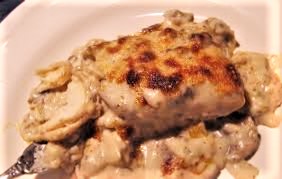
HALIBUT in CRABMEAT and MUSHROOM BECHAMEL


How about them photography skills ...

"The James Beard Cookbook," authored by the American chef and food authority James Beard, was published in 1959. It was revised and republished in 1970, and I am lucky enough to own one of the 1970 editions. James Beard brought French cooking to 1950's America. His legacy lives on in his numerous writings and cookbooks, and in the James Beard Foundation and its annual Beard awards. 


The jacket is long gone, but otherwise, the book is in very good condition.
It's nice to have one of his cookbooks around as a reference, and once in a while, I peruse its pages. Recently one of the recipes caught my attention: "fish in béchamel sauce." I decided to cook it, but I thought it would be an excellent idea to include mushrooms and crab meat in the béchamel!

Just a few minutes before sitting down to write this post I checked Beard's recipe once more. I noticed a "variations" section below the recipe in which Beard clearly states that both mushrooms and shellfish can be added to the béchamel. I had most likely read this ... Then forgot about it ... And claimed the idea as my own! Well, such are my adventures here in suburbia. Thrills and chills! Mushrooms and shellfish!  

Ingredients:


For the Béchamel sauce:
  • 5 tablespoons unsalted butter, at room temperature
  • 1/4 cup flour
  • 1 and 3/4 cups whole milk, warmed
  • 1/4 cup grated Parmesan
  • salt and pepper to taste
  • 1 teaspoon Dijon mustard
  • 2 tablespoons vegetable oil
  • 1/2 cup sliced mushrooms
  • 1/2 shallot, finely chopped
  • 1 tablespoon thyme leaves
  • 1/2 cup nice crab meat or you can even use shrimp
For the Halibut:

  • 1 bottle of fruity white wine
  • a few sprigs of parsley
  • a slice of lemon
  • a pinch of dried tarragon
  • 4 halibut fillets, about 1-inch thick
  • salt and pepper to taste
  • 2 tablespoons grated Parmesan cheese
  • 1 tablespoon unsalted butter, cut into small pieces
  • a few dashes of cayenne pepper

Directions:

Make the Béchamel sauce:
  • Saute the shallots in the vegetable oil until they become translucent. 
  • Add the mushrooms, the thyme, and some salt and pepper to taste. Cook until the mushrooms are soft and begin to give off their liquid. Set aside. 
  • In a 2-quart saucepan melt the butter over medium heat. 
  • Add the flour and whisk until smooth, but not browned.  
  • Gradually add the warm milk, whisking constantly to prevent lumps.  Simmer over medium heat, whisking constantly, until the sauce is thick and smooth, about 10 minutes. 
  • Remove the pan from the heat and stir in the Parmesan cheese, the Dijon mustard and some black pepper to taste.  
  • Add the crab meat and the mushrooms with their liquid and stir to combine.
For the halibut:
  • Preheat the broiler. Grease a baking dish that will comfortably fit the halibut and set it aside. 
  • In a large saucepan, add the wine, parsley, lemon, and tarragon, and bring to a boil over medium-high heat. 
  • Reduce the heat to a simmer and add the halibut. Cover the pan and poach until the halibut flesh is opaque, about 8 minutes. As you are cooking the fish, make sure the liquid doesn't come back to the boil. 
  • When the halibut has cooked use a spatula to carefully remove it from the saucepan and place it into the prepared baking dish. 
  • Season with salt and pepper.
  • Spoon the béchamel sauce over the fish and top with the Parmesan cheese.  
  • Dot with butter, sprinkle the cayenne over the sauce and broil until the sauce appears lightly golden, about 3 to 4 minutes. 

Tuesday, 17 August 2010

W


I believe that every tourist who visits Greece gets the chance to taste a dish of moussaka. It's a popular Greek summer fare made with layers of eggplant and ground meat which are topped with a fabulous bechamel sauce. 

To the best of my knowledge, in the old days, moussaka was exclusively layered with eggplants and ground beef, and then it was topped with bechamel. Sometime in the mid-twentieth century, chefs started adding potatoes to the layers of moussaka. A bit later, the addition of zucchini started comprising yet another layer. To be honest, I have yet not tried the zucchini addition but it's unavoidable that I will do so sometime in the future, and who knows, I may start adding it to my recipe. 

There are two methods of preparing eggplants for moussaka: One, is the old-fashioned method of frying them. I definitely say no to that. Two, is the wiser method of baking them in the oven: healthier, less messy, and even the flavour is better because the end product doesn't consist of oily eggplant. It's apparent there are variations to cooking moussaka. Here, I include my favourite version.

Moussaka can be prepared in advance and served lukewarm or at room temperature, making it ideal to serve for buffets. 

Ingredients:

3 or 4 medium eggplants
4 medium Yukon gold potatoes
extra-virgin olive oil
salt and pepper to taste
2 pounds lean ground beef, use a variety of 90% to 10% 
2 onions, chopped
3 cloves garlic, chopped
1 tablespoon tomato paste
3 bay leaves
a sprig of thyme
a sprig of rosemary
1/2 cup white wine
1 28-ounce can of whole tomatoes plus the juice included in the can.
1 cup of chopped parsley, divided
1 tablespoon dried oregano
1 cup fresh breadcrumbs
1 cup freshly grated Pecorino Romano cheese

For the bechamel:

6 tablespoons unsalted butter
6 tablespoons all-purpose flour
1-quart whole milk, heated
2 eggs, beaten
1 cup ricotta cheese

Directions:
  • Wash the eggplant and cut off both ends. With a vegetable peeler remove 1/2-inch strips of skin from the eggplant. The end result will be that your eggplant will have a striped appearance, showing stripes of purple skin and white flesh.
  • Slice the eggplants into 3/4-inch rounds. Season with salt and pepper on both sides.
  • Bake the eggplants: Preheat the oven to 350°F. Brush both sides of the eggplant slices with some olive oil and place them on parchment-covered baking sheets. Season lightly with salt and bake until the eggplants are soft. Keep an eye on the eggplant while it's baking. You don't want to overcook it. Baking time depends on the variety of eggplant used. Right away, place the cooked eggplants into a covered container and reserve. The cover will trap any steam they release and make them much softer and better tasting.
  • Peel and slice the potatoes. Slice them into 3/4-inch rounds. Place them on a parchment-lined baking sheet. Flavour them with olive oil, salt, pepper, and just a touch of oregano. Bake until the potatoes are soft and just beginning to brown. Reserve. 
  • Heat about 3 tablespoons of olive oil in a Dutch oven and add the ground beef. Stir occasionally, breaking the ground beef into small pieces. Cook until the ground beef is browned.  
  • Add the chopped onions. You may need to add a little more olive oil along with the onions. Cook until the onions are soft.
  • Add the garlic along with the bay leaves, thyme, rosemary and tomato paste. Cook for one minute and a half as you keep stirring. 
  • Add the wine and deglaze the pot. Keep stirring gently. Let the alcohol in the wine cook off and the wine itself become incorporated into the ground beef. 
  • Combine the tomatoes with the parsley. 
  • Add the tomato mixture to the pot, season with salt and pepper, and simmer over low heat, stirring often, until all the liquid has evaporated, about 45 minutes to an hour. Alternatively, you can place the pot into the oven and cook at 300 F for about 45 minutes to an hour, until the liquid has evaporated. 
  • Remove from the oven and add the tablespoon of oregano. Taste and correct the seasonings if needed. Cook on the stovetop for an additional five minutes.
  • While the ground beef is cooking, make the bechamel: In a saucepan, over low heat, melt the butter, add the flour and whisk for about two minutes. Turn up the heat to moderate and add the warm milk in a slow stream, whisking all the while.
  • Keep stirring as the sauce simmers. Within about five minutes the mixture should be thick. Season with salt and pepper to taste and remove from the heat.  
  • Let cool slightly and stir in the two beaten eggs and the ricotta cheese.  
Begin layering:
  • Grease an 11 by 16-inch pan and sprinkle the bottom with breadcrumbs. Arrange all the potatoes over the bread crumbs and top with half the eggplants. Sprinkle with grated Pecorino Romano cheese, breadcrumbs, and parsley. 
  • Add half the meat sauce on top of the eggplant layer. Sprinkle with grated Pecorino Romano cheese, breadcrumbs, and parsley. 
  • Add the rest of the eggplants. Sprinkle with grated Pecorino Romano cheese, breadcrumbs, and parsley. 
  • Add the rest of the meat sauce and sprinkle the top with, well, I guess you've guessed it: grated Pecorino Romano cheese, breadcrumbs, and parsley. 
  • Pour the bechamel over the top, sprinkle the top of the bechamel with Pecorino Romano cheese and bake in a preheated 350°F/180°C oven for about 30 minutes to 45 minutes, until the top is golden.
  • Let cool for half an hour before slicing. The moussaka will taste even better the following day.