Saturday, 2 November 2013

PIZZA DOUGH, GREEK STYLE: Pizza Shop Pizza Dough!


Wish I had one slice left. Even half a slice. I would settle for half of a slice. Unfortunately, it's all gone and I am left only with pictures and memories. Ah, the taste memories! I am eulogizing this pizza because it's not store bought, I made it myself. Made the dough, arranged the toppings, even used zucchini from my garden, and handpicked the basil leaves from the plant that grows on my patio. So I had special feelings about this pizza.  We had a relationship. It's over now. The pizza has been eaten. 


What can I say? I'm Greek and Greeks love bread! I would wager it's every Greek's favourite thing to eat. So just about any Greek who cooks knows how to bake bread with homemade dough. And they all like to argue about whose dough is the best. 


Now we come to the subject of pizza. Can you have pizza without dough? Perhaps in an alternate universe, it could be possible ... but hardly worth the experience. Since pizza depends on dough to become pizza, the pizza with the best dough makes the best pizza. Perfect the art of making dough, and you will have perfected the art of making pizza! 

Another important thing in pizza making is to have a flavourful sauce. Not a bland unseasoned sauce, nor a strong over-seasoned one, not a runny sauce, and not an extra thick and heavy sauce. Pretend you are a politician who has to tread in the middle of the political spectrum, then make your pizza sauce accordingly. But you will not have created a middle of the road sauce, instead, you will have a balanced sauce!

I'll tell you how I make my pizza; the recipe is tied and true and it makes an amazing pizza! 


Ingredients:


4 cups bread flour
1½  cups very cold water 
¼ cup smooth extra virgin olive oil
1 teaspoon salt
2 teaspoons sugar
2 teaspoons instant yeast
a little more flour, cold water and oil

Directions:
  • In the bowl of an electric mixer add the water, salt, sugar, oil and yeast. Using the paddle attachment, mix until the ingredients are incorporated. 
  • Switch to the dough hook and add the flour in 8 batches (1/2 cup increments), mixing after each addition. Mix until the dough is smooth and clears the sides of the bowl. 
  • Be patient and let it mix, but if it looks as though it's going to stay a little too wet, sprinkle more flour into the bowl and mix until done. If the dough starts to wrap itself around the dough hook and looks as though it’s heading out of the bowl, add some water. You want a dough that is soft and just a little sticky.
  • Sprinkle flour on your work counter and place the dough on top. 
  • Line a sheet pan with parchment paper and lightly oil the parchment. 
  • Cut the dough into pieces and weigh it: 14 to 16 ounces/400+ grams are good for a large pizza that will serve about 4 people, and 8 to 10 ounces/230+ grams are good for a smaller one that will serve about 2 people. 

  • Form each piece of dough into a round and place it on the sheet pan. 
  • Cover the dough with flour and then cover the pan it's on with a plastic bag. Make sure it's well covered.  
  • Place the pan in the refrigerator. It should stay there to rest overnight. 
  • Any dough that will not be used the next day can be individually wrapped in plastic, placed in a freezer bag and frozen. It can be kept in the freezer for 2 to 3 months.

To make a pizza:


  • Place a dough ball on the counter. If frozen, let it come to room temperature. Cover it with flour and flatten it with the palm of your hand. Let it rest for 20 minutes and then flatten it to the appropriate size by using a rolling pin.


  • I don't like to bake my pizza directly on top of a pizza stone. I use a pizza pan, and I place the pan on the pizza stone. So at this point, I place the dough in its pan and I stretch it with floured hands until it has reached the sides of the pan. If the dough shrinks back from the sides, let it rest for a few minutes and it will become pliable and stay put and do what you want it to do.  
  • I use a pan with a 14-inch diameter for a large pizza and a pan with a 10-inch diameter for a small pizza.

  • Once the dough is stretched out in the pan, it's time to spread on the sauce. Two tablespoons of sauce for the small pizza, or four tablespoons of sauce for the large one. After that, I sprinkle on the cheese.
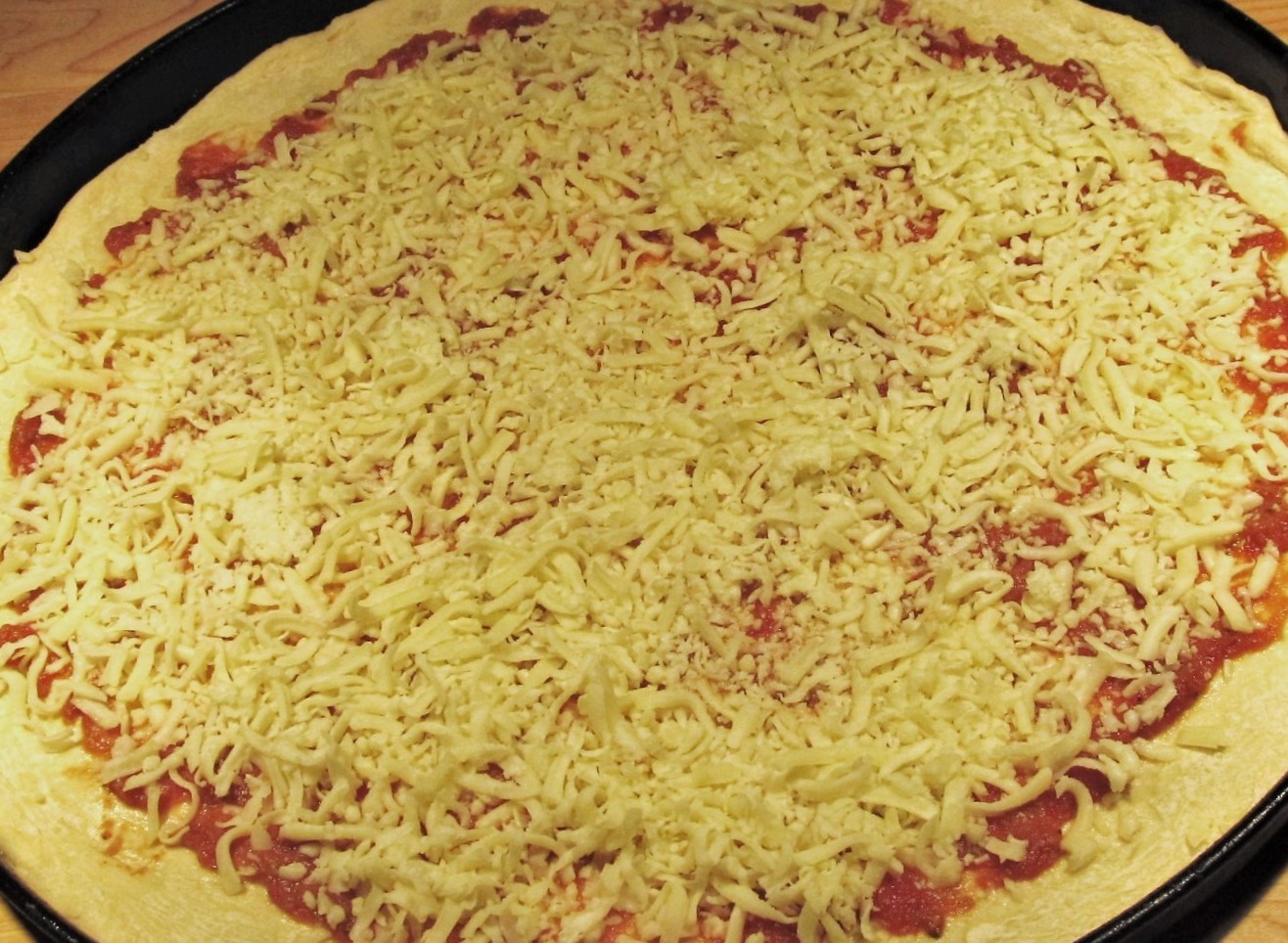
The type of cheese I like to use is shredded mozzarella mixed with a good shredded cheddar. In my opinion, this combination tastes best and in addition, gets rid of the problem of dealing with an elastic cheese which is what mozzarella turns into when left to its own devices. I like a 60/40 blend: 60 percent mozzarella, 40 percent cheddar.
  • At this point, the dough has to rest again so that it can rise. Cover it with plastic and let it rise for about 2 hours. If the pizza will not be cooked after the 2 hours, it can wait in the refrigerator.
Zucchini and olive pizza! Use what you have on hand. I had all those vegetables in my refrigerator - no need for a trip to the grocery store. A nice touch was the fresh mozzarella on top and the sesame seeds around the border of the pizza. Actually, I hesitate to make pizza without that sesame seed border ... It's kind of my signature, I think. 

  • When ready to cook add any toppings that will be used. The oven should be preheated to 450ºF/230ºC. Place the pizza in the oven, on top of the pizza stone. Baking time will be approximately 8 minutes.
  • If the top cooks before the bottom, next time move the pizza stone to a lower shelf. If the bottom is nice and crisp before the cheese and toppings are browned, then next time the stone should be placed on a shelf that sits higher in the oven. 
  • Always check: before starting to bake the pizza make sure the oven is nice and hot. 
Ready!

  • Take the pizza out of the oven and with the use of a long knife or spatula transfer it to a cutting board. Don’t slice it yet. Inhale all the different aromas arising from it! You will smell the freshly baked dough, the melted cheese, the fragrance of roasted vegetables if any have been used. You will feel the heat rising up from the pizza, and the heat will spin all those fragrances around the room. Then look at all the lovely colours. Admire the golden dough, the redness of the sauce ... is it any wonder pizza is the world’s favourite food? Is there anyone who does not love pizza? 
  • Okay, now it’s time to stop admiring. Your pizza, she is ready to be eaten! It needed a few minutes of admiration so that its beauty could be thoroughly appreciated, but also so that the cheese could slightly set, becoming easier to slice. Well, what are you waiting for? Slice that baby and… you know what to do after it's sliced, don't you? Don't you?  

Monday, 28 October 2013

PIZZA QUATTRO STAGIONE for 'A VERY PRIVATE GENTLEMAN"


I thought I knew all there was to know about pizza.  After all, I can make really good pizza, and I have been making it for years. (The secret to good pizza is in the dough.  If you have a good dough, chances are you'll have a good pizza). But, surprise, I found out something new about pizza.  here exists a topping I didn't know of. No, it's not ham and pineapple. It's Quatro stagione, or four seasons pizza.

Marinated artichokes for springtime...

Tomato slices and fresh mozzarella for summer.  Sliced basil goes on after the pizza comes out of the oven.  I enjoyed slicing the basil, it gave off such a wonderful aroma...

Autumn, represented by sauteed mushrooms and onions...

Ham, for winter. Or, if you prefer to have no meat on your pizza, choose olives and rosemary as a winter topping. Perhaps some of those pepperoncini peppers or some capers ...  

Make the pizza.  Dough, sauce, cheese. Visually divide the pizza into four sections, and top each section accordingly.  The toppings can vary, as long as each section they are placed on represents one of the four seasons.

Bake it, and enjoy it.  Whoever thought of the concept of a four seasons pizza is a certified genius as far as I am concerned. Scrumptious. A wonderful excuse for having a multi-topping pizza. Except, this way, the toppings are not piled one on top of the other, which truthfully, I find unappetizing. Here, the toppings are artfully arranged on the pizza, giving it an air of sophistication.   And I like sophistication. That's why I really liked reading the thriller A Very Private Gentleman, (1990), written by Martin Booth. As far as thrillers go, it reeks of sophistication. As do I. 

This is my contribution to Novel Food, the literary-culinary event hosted by Simona from Briciole. Read it, and then cook something that the reading has inspired you to prepare.  For this edition of Novel Food I enjoyed reading A Very Private Gentleman.  

In one of my favourite chapters, the main character takes his paramour to an out of the way restaurant where the two enjoy a bottle of wine and a "pizza quatro stagione." I loved the description of the event so very much that I wanted to be a patron at the very same countryside restaurant, ordering along with the protagonists. 

a VERY private gentleman


This is a thinking person's thriller, with an unforgettable protagonist. He is Signor Farfalla, thus called by the locals of the small town where he lives. He is an artist who paints rare butterflies. Or so he pretends. That's his cover.  In actuality, Signor Farfalla leads a life so secretive that even we, the readers, don't know his real name or nationality. He is well educated though, a man of fine tastes. He knows how to appreciate nature, art, architecture, good food and wine, good music and books, and he loves good company. He always moves from place to place, sometimes because of work, sometimes to evade capture. His real work is done in secret: he is a gunsmith who crafts made-to-order weapons. They carry a very high price tag because they are used for high level assassinations. And Signor Farfalla feels that he has helped to shape history. However, he is getting old and would like to retire. When we meet him, he is promising that he's working on his last commission. He likes the small Italian town where he's taken up residence, and he would like to settle there, in the company of Clara, a young student who moonlights as a prostitute in order to make ends meet. Unfortunately, just as Signor Farfalla makes up his mind to settle down, he becomes aware that someone is after him. And so the cat and mouse game begins... Booth's writing is clear, intelligent, tense and thought provoking. 

A Very Private Gentleman is a first rate psychological thriller, a book that is hard to put down. 


The movie The American (2010), staring and produced by George Clooney, was based on this novel. The script has some significant differences from the novel, but both movie and book are first rate. With the release of the movie, the novel was republished under the same title as the movie. Therefore, a very private gentleman was forced to become an American. I don't think Martin Booth (who died in 2004), would have liked this change; he didn't give his character a nationality, and I enjoyed trying to guess where Signor Farfalla could have come from.  

And yes, I find George Clooney aesthetically pleasing. 


Saturday, 14 September 2013

CORN ON THE COB GRILLED WITH FRESH HERBS


Corn on the cob on the grill.  A great way to enjoy summer sweet corn! This corn was as fresh as could be. I bought it just a few hours after it was picked, and at a really sweet price too, 4 for $1.00. I often grill corn: I love eating it hot, crunchy, and slightly charred, but with kernels that are still juicy and sweet below their crispy coat. My way of grilling corn is to wrap it in parchment paper, then in aluminium foil and toss it onto the coals; I have been cooking it this way for more years than I can count.


I never considered improving on the taste, not until I came across a picture on the Food Network website of corn grilled in foil but with lots of herbs added for extra taste. 


Well, go figure. I grow herbs and I have a clear view of my little herb garden right from where the grill is set up. Yet, never once did I consider adding some of those herbs I stare at to the corn grilling in front of me. OK, thank you Food Network for kicking my brain into gear. 


This is kind of a no recipe-recipe but here is what I do these days when I grill corn: 

I place a piece of foil on the counter. I top it with parchment paper. Then I begin seasoning the corn with spices and herbs. Use any herbs you love or have on hand. I usually incorporate rosemary, thyme, sage, marjoram, chopped garlic, olive oil combined with a little butter, and salt and pepper. I wrap the corn securely and place it on the grill!  


The corn package should be rotated every three to four minutes to keep it from getting scorched. Total grill time is usually about twenty minutes. When the corn is ready, I unwrap the package and wait until the corn cools down a little. Sometimes I like to top the corn with grated Pecorino Romano cheese. Then I serve it on a bed of basil. The taste imparted by the herbs is not overpowering. The corn flavour is still dominant but the herbs add to it a subtle, excellent note. This method of cooking corn has won me over; there is no going back! Corn grilled with herbs is where it's at!


Friday, 6 September 2013

Broccoli Mushroom and Potato Soup


Creamy but without the addition of cream, this healthful soup is made with a base of potatoes: buttery-tasting Yukon gold, my favourite. Mushrooms add a woodsy, earthy flavour, and the broccoli contributes green notes. Some broth, some herbs, a little grated cheese, and in about half an hour, soup's on! A delicious soup, a "make you happy" kind of soup.  

I pureed the ingredients until they reached a smooth consistency. Leaving them chunky would have been good too, but maybe next time. This time I was in the mood for smooth textures. Too many sharp edges in my hurried life, therefore I was yearning for a bowl of nourishing soup, some warm and comforting soup to smooth, albeit temporarily, life's sharp edges. I chopped, sauteed and boiled, breathed in the aroma of the broth, and anticipated my first serving of hot, thick, smooth soup. 

Eat this soup when it's really hot. That's when the flavours are at their best. And crunch on some crackers when you're between spoonfuls. Slurping is optional.


Ingredients:

4 tablespoons olive oil
1 large onion, chopped
3 cloves garlic, chopped
5 Yukon gold potatoes, peeled and cut into chunks
1 pound mushrooms, sliced
2 heads of broccoli, cut into florets 
6 cups vegetable broth
salt and pepper to taste
½ cup grated Pecorino Romano cheese
1 bay leaf
about 10 sprigs of parsley
1 tablespoon fresh thyme leaves

For the garnish, to be prepared while the soup is cooking:
Save a few sliced mushrooms and some broccoli florets. Have some chives on hand. Chop them up.
The mushrooms should be sauteed and the broccoli can be boiled, but it needs to be blanched so that it can retain its green colour.


Directions:
In a large pot heat the olive oil. Add the onion and cook, stirring occasionally, until translucent, about 5 minutes.
Add the garlic, broccoli, mushrooms and potatoes.  Stir and cook for another 5 minutes.
Add the broth, salt, and pepper, bay leaf, parsley, and thyme. 
Bring to a boil, then reduce the heat and simmer until the vegetables are tender, about to 20 minutes.
Using an immersion blender puree the soup. 
Stir in half the cheese and mix well. Serve garnished with chopped chives, sliced mushrooms, tiny broccoli florets and the rest of the grated cheese.

Sunday, 4 August 2013

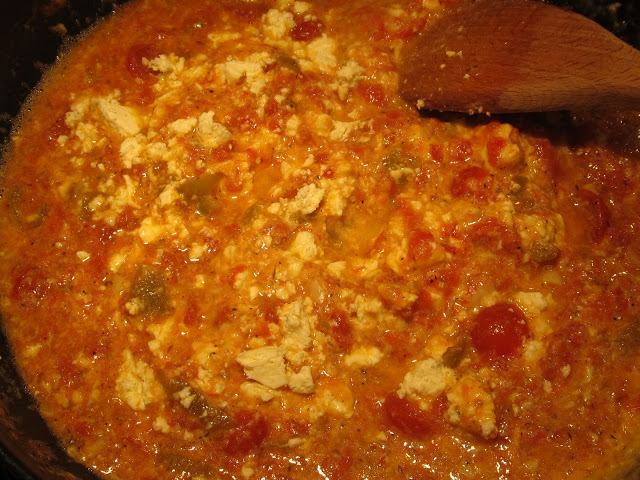
STRAPATSADA FLAVORED WITH PEPPERS


A plate of strapatsada is one of my favourite Greek meals. It tastes like summer! It's because of the tomatoes, I think. When they ripen and turn bright red they bring that special taste to this dish. The salty feta cools things off, and the eggs bind all the ingredients together. 

There are about as many variations of strapatsada as there are regions in Greece. In the north, peppers are added. In some islands, feta cheese doesn't even make an appearance. The most popular version is the one with eggs, feta and tomatoes, and that's the one I prefer. I don't grow peppers, but once in a while friends bring me peppers from their garden. That's when I like to throw this version of strapatsada together. Just a couple of peppers, one mildly hot and tangy, the other sweet and tender, just two peppers will add an appealingly piquant note to strapatsada. Try it. Use the freshest ingredients you can get, and you'll have a delicious, nutritious and economical dish! 


INGREDIENTS:

6 large fresh tomatoes, peeled, seeded and chopped
2 cloves of garlic, minced
1 long green hot pepper, seeded and sliced into thin rings
1 sweet Italian frying pepper, seeded, sliced in half lengthwise and chopped
4 or 5 eggs, beaten
salt and pepper to taste
dried oregano
feta cheese, crumbled
2 tablespoons milk 
2 tablespoons olive oil


DIRECTIONS: 

In a skillet, heat the olive oil and add five of the tomatoes.  Season with salt and pepper, add the garlic, oregano and peppers, stir to combine and cook over medium heat until the liquid from the tomatoes has evaporated. Add the reserved tomato and mix.
 

Add the milk to the beaten eggs then pour the egg mixture onto the tomatoes.  Cook while constantly stirring the mixture in a folding motion. The eggs should become incorporated with the tomatoes but they should not get overcooked or burned. 

 Freshness here is key: get the best organic eggs!


 Just as the eggs are about to finish cooking, add the feta cheese and continue cooking and folding for about another minute or so.  


Plate the strapatsada and serve it hot with toasted bread as an accompaniment.


Monday, 29 July 2013

WHEN YOU'RE EATING TO LIVE TRY THE POLENTA: REFLECTIONS ON READING MFK FISHER'S "HOW TO COOK A WOLF"

“By all means marry; if you get a good wife, you'll be happy. If you get a bad one, you'll become a philosopher.” That’s what Socrates said, and it’s well known that he had an unhappy marriage. Therefore, he became a philosopher. I imagine his wife was a horrible cook because soon after Socrates became a philosopher he coined this phrase: “Eat to live, do not live to eat.” I think what Socrates meant was not to be a glutton or engage in debauchery. Keep to the middle of the road, don’t go overboard. 

I like to remember the “eat to live, do not live to eat” quote every time I go to the supermarket. Everything there is strategically arranged to tempt the buyer! That’s what you call marketing (pun intended). Before you know it, you’ve bought a whole host of things that you have no use for. That’s excess, and that's not a good thing. Socrates would be disappointed as would be MFK Fisher; MFK eschewed excess. Of course, when times are hard, excess is difficult. When the "wolf is at the door," meaning when one is faced with difficult times, ingenuity must come into play. 

MFK Fisher’s book “How to Cook a Wolf,” written during World War II, is devoted to giving ideas on how to eat well during hard times. The book's premise is how to master the proverbial wolf rather than let him threaten. Keep calm, be ingenious, and persevere. That's "How to Cook a Wolf!" Clever title, enjoyable book. This was my introduction to MFK Fisher (Thank you, Simona). Fisher was a bohemian, a cook, a gourmet, a journalist and a pioneering food essayist. In her book, she discusses food shortages, rationing and other difficulties faced in the US during the World War II.  

Her observations about food contradicted what was commonly believed at the time, but she was right on target: Eat lots of fresh vegetables she said. Have a nice, big salad. Don't forget about seafood. If you have wilted vegetables, they're perfect for soup. Make sure your eggs are fresh, even if you have to pay a little more. It will be worth it in the end. Make your food stretch by adding rice or potatoes to it. Save on gas: your oven can accommodate more than one dish at a time. Add the dessert in there along with the main course ... Her ideas about fresh food and food economy are conveyed in a clever, appealing manner. One of these days I may have to try baking her tomato soup cake. Tomato soup? In cake? It's been heard of. It was a pretty common Depression-era and wartime addition to spice cake. Tomato soup was the "mystery ingredient" which allowed cooks to economise on the use of oil/butter, milk, eggs, and sugar. MFK doesn't tell us, but tomato soup makes a cake moister and sweeter. Of course, you know ... don't add it when making a genoise ... 


 MFK Fisher's "How to Cook a Wolf" is the entry for COOK THE BOOKS CLUB,  this round hosted by Simona from BRICIOLE.  Read the book, cook what inspires you from the reading, then blog about it.  That's the objective! 

I would not have been able to praise Fisher had I not decided to write what follows, some of my thoughts concerning food shortages in wartime Europe. Once I had those thoughts on paper, I felt a sense of relief and was able to go back and reread "How to Cook a Wolf" with enjoyment. It was Fisher's chapter on how to manage during blackouts that brought back memories of stories heard from relatives concerning how they dealt with blackouts. And with curfews, too. And with fear. During World War II, my family lived in Greece, which was under nazi occupation. Things there were just a tad more serious than in the US (of course, if not for US soldiers, who knows what Europe would look like today). 

In her book, Fisher explained such things as how to cook a tough cut of meat. During the war, my family felt they were rich if they could eat bean soup for dinner. My grandfather was imprisoned and nearly shot because he bought meat from someone who butchered a cow without having gotten permission from the authorities. Needless to say, the man who butchered the cow (his own cow), was shot. Shot dead. Knowing all these stories, plus lots more, I initially reacted to Fisher’s book with commingled feelings: with interest, because this is a charming book, but also with disdain because I knew and sympathised with people who had it a lot worse than Fisher's intended readers. In wartime America, food was plentiful albeit rationed. In Greece, food was a luxury and near starvation was the norm. Tell me MFK, how do you make a nice meal out of just a handful of raisins? I really don't think MFK, knowledgeable as she was, would have had an answer.

But if during World War II my relatives considered beans to be a rich meal, polenta was their staple meal. They would eat polenta nearly every day. My grandfather was the polenta guru of the clan, cooking it over an open fire in the yard, and stirring it all the long time it needed to be stirred. Then he would take it to my grandmother who poured it onto a platter and flavoured it either with petimezi (a syrup made from grapes), or with feta cheese: Polenta made either sweet or savoury. My mother once told me that she loved the sweetened petimezi polenta. I believed her 100 percent because mom was known for her sweet tooth and for the desserts she made! 

Fisher has a very nice recipe for polenta in the chapter "How to Pray for Peace," and she aptly describes the starchy cornmeal concoction that is polenta as "a sturdy... mixture, the kind that has survived centuries of loving obedience from hungry, simple peoples."  
   
Strapatsada

I would like to dedicate this post to the persevering spirit of my relatives and the like-minded spirit of all war-torn families. For this entry of Cook the Books Club, I cooked two dishes that I heard lots about from my mother: Strapatsada, a dish made with tomatoes, eggs and feta cheese, definitely a luxury food during the war. Strapatsada is reminiscent of Fisher's recipe "eggs in purgatory," known across the pond that is the Atlantic Ocean as "uova in Purgatorio." 

I also made polenta, which was my family's wartime staple. After the war, polenta all but disappeared from Greek dinner tables, but strapatsada is still a favourite.

Here is a pertinent war-time story: my cousin Socrates was born during World War II. I am very fond of Socrates, he is a righteous dude. He is named after Socrates, the philosopher. This is how that happened:

Soon after he was born, the yet unnamed baby Socrates was taken to church, ready and willing to be christened. It’s a Greek tradition to name the newborn after his or her grandparents. And there was the problem. The baby's mother wanted her son to have her father’s name, and the baby's father wanted his son to have his father’s name. For days, the back and forth had been: 

"It's going to be Nicholas!"
"No, it's going to be Constantine!"

Husband and wife could not agree (sound familiar)? They arrived at church still arguing about names. Now the godmother of the baby was to be my mother, who at the time was about 12 years old. Godparents in Greece have special powers. They can execute a coup, and give the baby a name of their own choosing. My grandfather saw that the argument between the baby’s parents was not going to be settled anytime soon, so he approached my mother. 

“Tell the priest to name the baby Socrates,” he whispered in her ear. 

As a compromise, grandfather decided to have the baby named after one of the famous ancient Greeks. You know, Socrates, the philosopher who said “eat to live, do not live to eat.” So the ceremony started, and when the priest asked:

“What is this servant of God going to be named?” my mother belted out: 

“Socrates!” 

So Socrates it was, and Socrates it is. After every christening, there always follows a big celebratory dinner. That’s the point of this story: what do you serve when there is nothing much to be had? Vegetables! My grandparents grew tomatoes in their yard. Plus they had some chickens they kept for the eggs, plus they always managed to get feta cheese. (How they got feta cheese during the war is a very long story. I can email you the details). With those ingredients on hand, they made strapatsada. Lots and lots of strapatsada. And the sweet kind of polenta. And a salad too. A really big salad. Plus they had homemade noodles flavored with olive oil and more feta cheese. Then, there was fruit for dessert. My mother always spoke about that dinner. In the midst of deprivation such a feast made a big impression. I think MFK Fisher would have been pleased with the results. 

Thank you for reading my post, but I am not finished. Reader, hang on. I have one more thing to add: 

Socrates, I love you!